
Nestled beneath the towering peaks of the Georgian Caucasus, where thousand-year-old stone towers pierce the mountain mist like ancient prayers frozen in time, lies a village slowly — and inevitably — surrendering to the modern world. Ushguli. Even its name whispers of mystery locked behind sky-splitting summits.
In the Shadow of the Georgian Caucasus
Our journey began long before our feet touched the trail. It started with a night flight and continued with a grueling drive from Kutaisi to Mestia. Not even the majestic peak of Ushba, rising dominantly above the surrounding mountains, could distract us from the relentless jolting of the road. After four or five hours on a half-finished concrete road, which felt like the mountain shedding its skin, we finally arrived. Mestia greeted us at 1,500 meters above sea level.
We hadn’t expected an easy journey. But after more than 24 hours of travel, nothing sounded more heavenly than a shower and a bed. After a short rest, we set out to explore. And of course, the first to greet us were the Mestia towers — rising like majestic stone sentinels.

The Towers of Svaneti
Built between the 9th and 12th centuries during Georgia’s golden age, these towers are rooted in history, making them among the oldest continuously inhabited defensive structures in the world. Standing four to five storeys tall, they served as fortresses against invaders and as protection from blood feuds. There’s a similar tower in Montenegro — the Redžepagić Tower — but it’s five centuries younger and fully renovated.
What fascinates me isn’t just their age, but their continued presence in daily life. These architectural marvels have survived a millennium of families, feuds, and conquests — and still serve a purpose. Children play in their shadows. Some are open to tourists. We stumbled upon the Ratiani Tower by chance, following wandering cows and children through Mestia’s narrow streets. For 10 Lari (about €3), we stepped into the world of the ancient Svan people.
Inside, the stairs felt built for giants. On the first floor, goat and dog bones greeted us. Though Georgia was the first country to officially adopt Christianity in the 4th century, whispers of ancient gods linger in pagan rituals and animal sacrifices. I shook off the chill and climbed higher. At the top, I wondered how many families had waited here for invaders to give up — and how many never made it out. These towers were places of refuge long before gunpowder existed. A Georgian flag fluttered above, and the view was breathtaking.
Grandfather Ratiani led us to the ground floor of his home, showing us where his grandfather kept livestock. Speaking in Russian, he explained how smoke preserves the wood and the structure. His hospitality and enthusiasm were overwhelming.
Legendary Georgian Hospitality
When Georgians drink, every toast is a celebration — elaborate speeches of gratitude and honor. It didn’t take long for us to adopt this tradition as our own.
We raised our glasses to the towers waiting deeper in the mountains.

A Walk through Time: Trekking from Mestia to Ushguli
After exploring Mestia — its museum, Queen Tamar’s statue, cable car, and panoramic views — and sampling local beer, chacha, khachapuri, and other delicacies (plus a warm welcome from the local insects), we began our trek to Ushguli and the Shkhara Glacier.
Covering 76 kilometres and 3,400 metres of elevation gain, this journey was a hike but it was also a walk through time.
- Day 2: Mestia to Zhabeshi — 16 km of gradual ascent, gaining 800 metres. The trail passed through fragrant meadows and forests, ending at a mountain pass with a rustic café.
- Day 3: Zhabeshi to Adishi — 18 km with the steepest climb of 1,000 metres. Here, distance got another dimension. The deeper we ventured into the mountains, the further back in time we travelled. Civilization faded. The only vehicles were tiny Suzuki tractors, the only ones narrow enough to pass between houses.
- Day 4: Adishi to Iprari — Our longest day: 18.6 km, crossing the Chkhunderi Pass at 2,719 metres. At the summit, we understood why the Svans built towers. The view stretched to distant peaks — silent witnesses to the rise and fall of empires. We crossed a river on horseback, the glacial water reaching the saddle. It felt mythical — a moment suspended in time.
- Day 5: Iprari to Ushguli — The final 16 km descent to Europe’s highest permanently inhabited village. Endless fields of wildflowers and rhododendron-covered hills welcomed us. Ushguli appeared, its towers raised like fingers defying time. Cowbells marked the rhythm of the seasons. A large, scarred dog joined us.
- Day 6: Shkhara Glacier and return to Ushguli — Here, things older than humanity reside. The glacier, a wall of dirty ice and stone, is now significantly smaller than just eight years ago.

I can’t clearly recall where we slept each night or how the days passed. One afternoon, we held a party in a wooden tower so rickety that even laughter felt dangerous — but that didn’t stop us from singing our team anthem. Perhaps that’s the essence of trekking with good company: losing track of time and space, surrendering to the moment, and forgetting the worries of the real world.
What swept me away was the culture, tradition, and history of Svaneti.
Tradition and the Women of Georgia
At 2,100 meters, Ushguli exists in a time of its own. The village inspired the film Dede by Mariam Khatchvani — a living museum of medieval life. We watched it inside one of Ushguli’s ancient towers — a cinematic experience as it should be: a revelation.
The film portrays the harsh realities of traditional Svan culture — abductions, arranged marriages, children belonging to the father’s side, blood feuds — practices that persisted into the 1990s. Yet it presents them as survival mechanisms in a world where isolation meant self-reliance, and communal bonds were the difference between life and death.
Some scenes mirrored our own experiences — we saw five-year-olds riding horses, oxen pulling sled-like carts through narrow streets. Leaving the “cinema” felt like stepping out of the film itself. We half expected snow to fall.
Mariam, the young director, welcomed us with her child, answering questions on her own red carpet — her home — embracing tourists, explorers, and hikers, inviting us into her world.
Her photo wall outside the “cinema” reminded me that centuries ago, a woman ruled this land. Queen Tamar, Georgia’s legendary 12th-century monarch, was called “king” to emphasize her power. Her empire stretched from the Black Sea to the Caspian.

She reminded me of the book I brought for this trek — The Eighth Life by Nino Haratischwili. Nino, also a woman, tells the modern history of her family through female characters in the 20th century. Her story could be set in Paris or New York — ballet, parties, education, sisters, broken dreams — if not for the presence of Stalin, Beria, gulags, torture, and tanks in the streets.
On our journey, we mostly spoke with women. They were our hosts, our support, our gateway to Georgia. Yet this society feels ruggedly masculine — perhaps shaped by the mountains and the harshness of life. But are these women — Mariam, Tamar, Nino, and those who welcomed us — the pillars of life and family in a culture ruled by men? Do they stand like towers, supporting everything?
That’s how I feel about Montenegrin women. Though we haven’t had queens — not since Teuta, from a distant past.
Svan culture is one of humanity’s greatest preservation successes. For over a thousand years, the Svans have maintained their identity not through conquest, but through stubborn survival. The Svan language, spoken by fewer than 30,000 people, is entirely distinct from Georgian. Is this the mountain people’s determination to hold onto their roots? Or is it isolation? Did the mountains protect and preserve this culture?
Return to Reality
Returning to Mestia after five days in the mountains felt like a jolt back to reality. The bus seemed bigger, the road smoother. Even Mestia looked larger and more vibrant than when we first arrived.
It felt like everything had changed. Or maybe we had.
The mountains changed us — the walking, the sleeping in villagers’ homes, Ushguli, the towers, the glacier. By now, we should know: mountains rarely offer anything less than transformation. And they rarely disappoint those who answer their call.
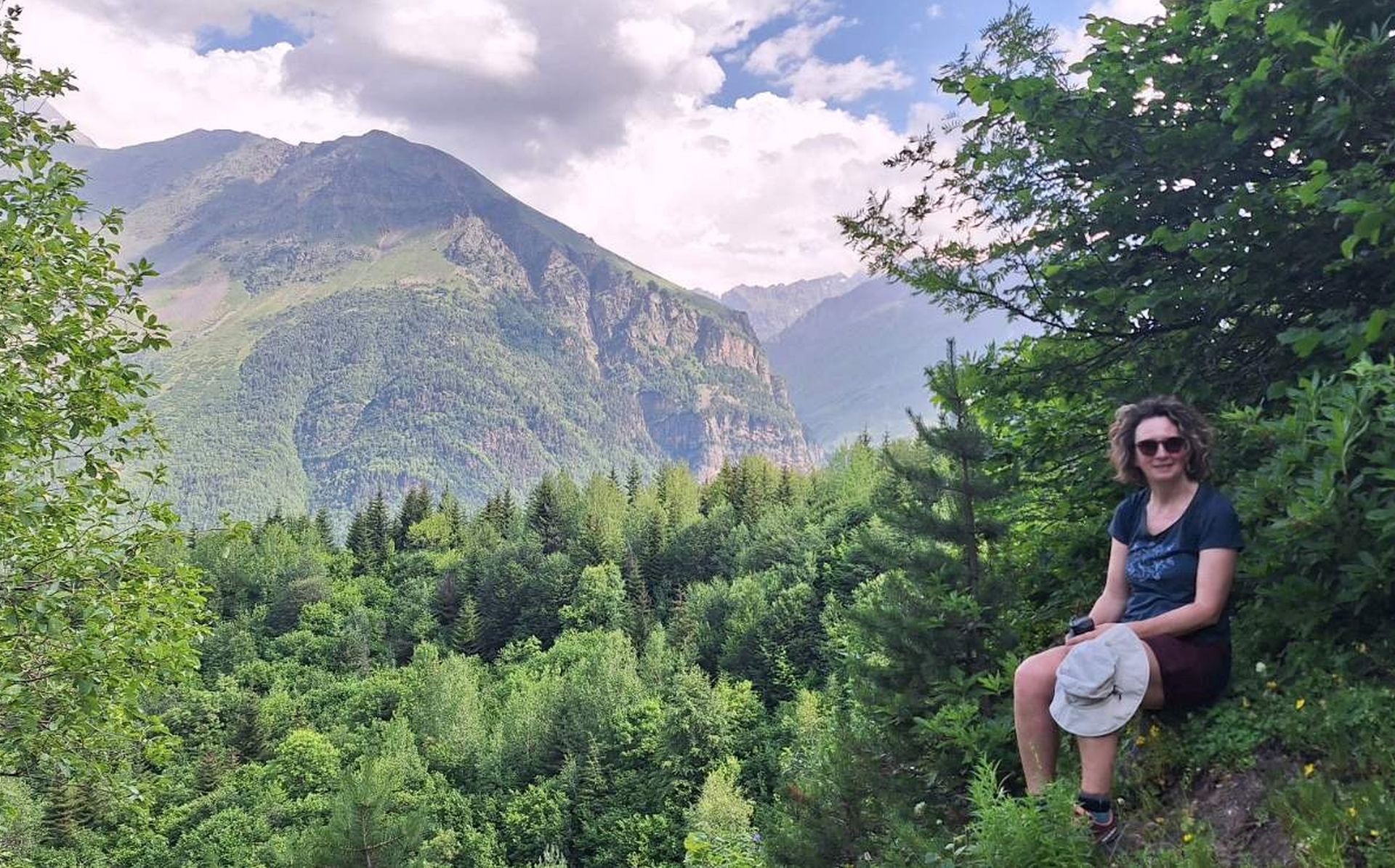
A Toast
And so, in the spirit of Georgian tradition — where every drink is a toast — here’s mine:
- To our young guide-in-training, a 19-year-old girl with invisible, universal courage — building bridges between worlds, leading others forward, carrying change across borders and traditions. For Iman.
- To two fairies — Iskra, whose story and energy match her name, and Ivona, a forest Galadriel with piercing blue eyes. And to the twins — alike in appearance, opposite in nature, both shining in their own way.
- To the parents who brought them.
- To Queen Tamar, movie director Mariam, and writer Nino. To the abducted women and those separated from their children. To the women who ruled kingdoms, told stories, built towers, and raised children.
- To half-built roads, preserved towers, and ancient languages.
- To harsh traditions and their beauty that shape the future.
- To the rivers and towers that outlived empires.
- To khachapuri and chacha.
- To Team KOG+ and the new generation.
- To Svaneti — where every step backward through time is a step forward in understanding what makes us human.
Cheers!