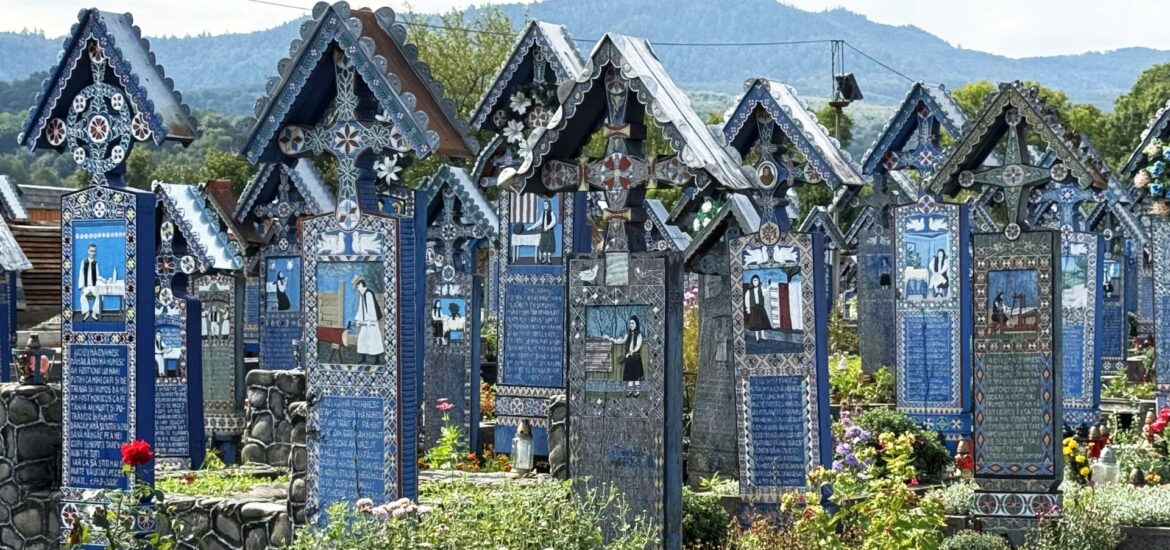
The Merry Cemetery (Cimitirul Vesel) of Sapanta in the county of Maramures is one of the top tourist attractions in the northern part of Romania. It attracts over 200,000 visitors annually, although Sapanta is a small village with 3,500 inhabitants only.
Honestly speaking, when we planned to visit the Merry Cemetery during our round trip through Romania, I didn’t know what to expect. How could a cemetery be ’merry’? But when we finally visited Sapanta, I understood why this cemetery is unlike any other in the world. Just imagine: a cemetery without grey granite headstones and memorials, but with 800 colorful wooden crosses, decorated with naive paintings and epitaphs that reveal the stories of people’s lives – sometimes ironic, sometimes painful, but always as a celebration of a life that ended.
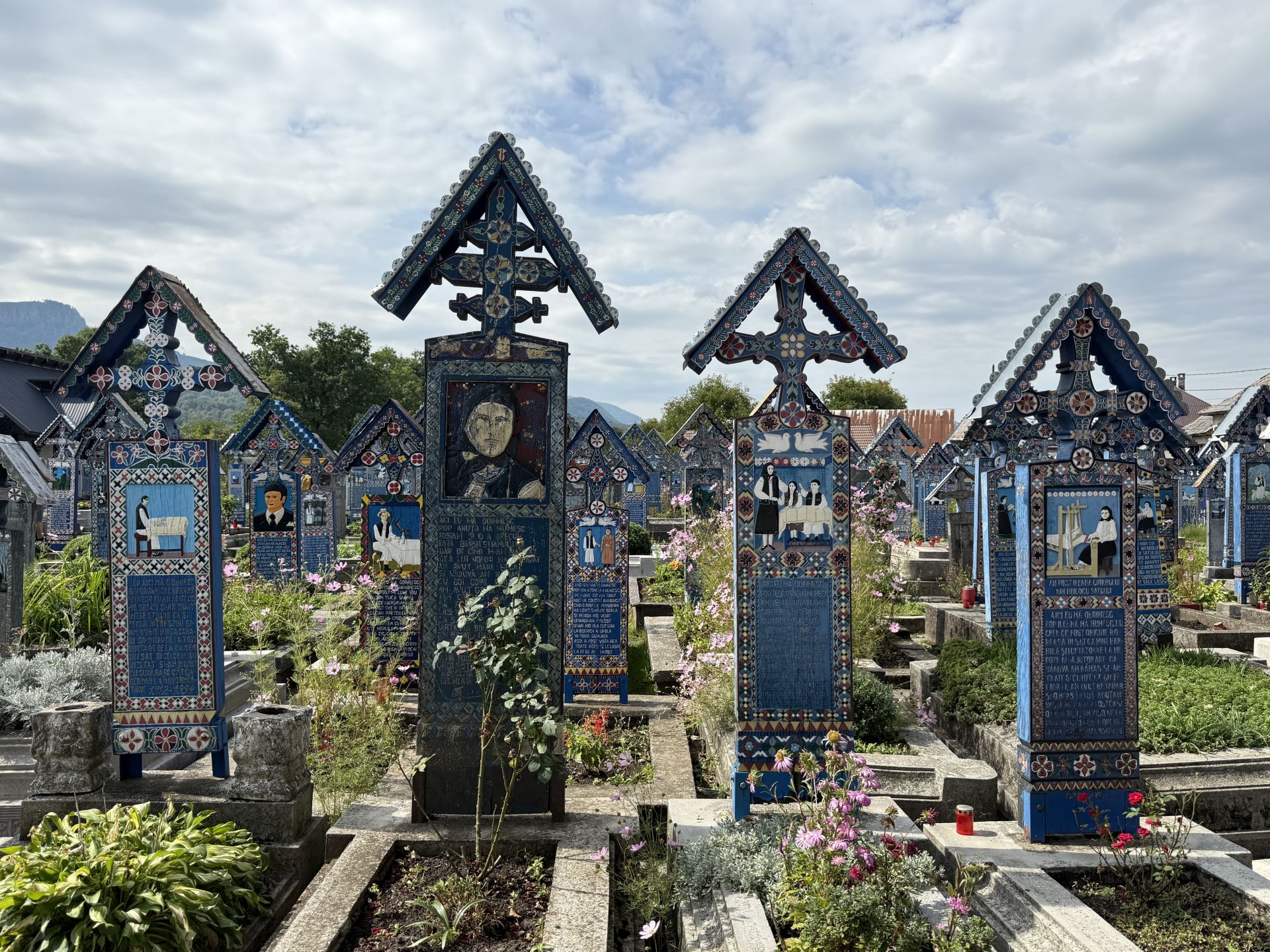
The first thing that surprised me was the explosion of colors in folk-art style, with ’Sapanta blue’ as the basic color. Each cross was telling a life story that was meant to be read and remembered for generations.
Roaming around the cemetery, I realized that I was not just walking among graves. I was meeting people – teachers, children, farmers, shepherds, housewives – ordinary lives preserved in a unique way.
Who invented this ’blue village of the dead’ and why? The creator of the cemetery was Stan Ion Patras (1908-1977), a local carpenter and sculptor who made a living by carving wooden gates and crosses for the cemetery in his village. He wanted to abandon the idea of traditional gravestones and in 1935, he started to carve epitaphs on wooden crosses. An epitaph was a short poem, written in the first person – some of them were cheerful, others were sad or ironic. At first, he was carving around 10 crosses annually, but gradually he filled the cemetery with 700 carved and painted crosses and he became famous. After his death in 1977, his work was continued by his most talented apprentice, Dumitru Pop Tincu.
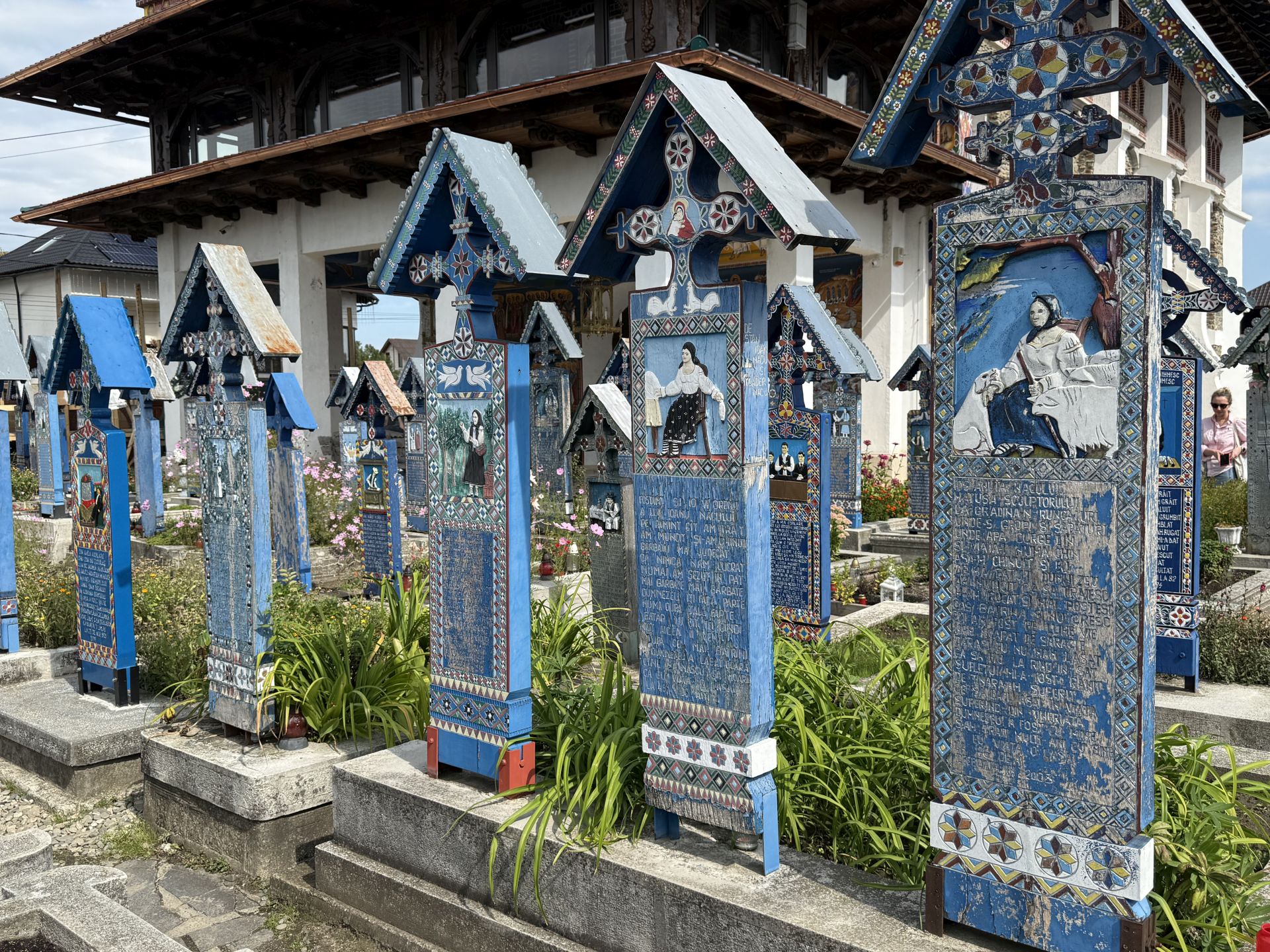
Of course, the graveyard was not always called ’Merry Cemetery’. This expression came from a French journalist who discovered it and presented it to the outside world. When he saw the bright colors of the crosses and the satirical epitaphs carved on them, he exclaimed: ’This is a merry cemetery!’ and so it remained until today.
By the way, it is said that this joyful attitude towards death is a legacy of the Dacians who believed that death was only a passage to a better life.
As we visited Sapanta in September, we succeeded in avoiding the crowds. The souvenir shops and pubs around the cemetery were almost abandoned, but I could imagine how the place would look like in the summer season…
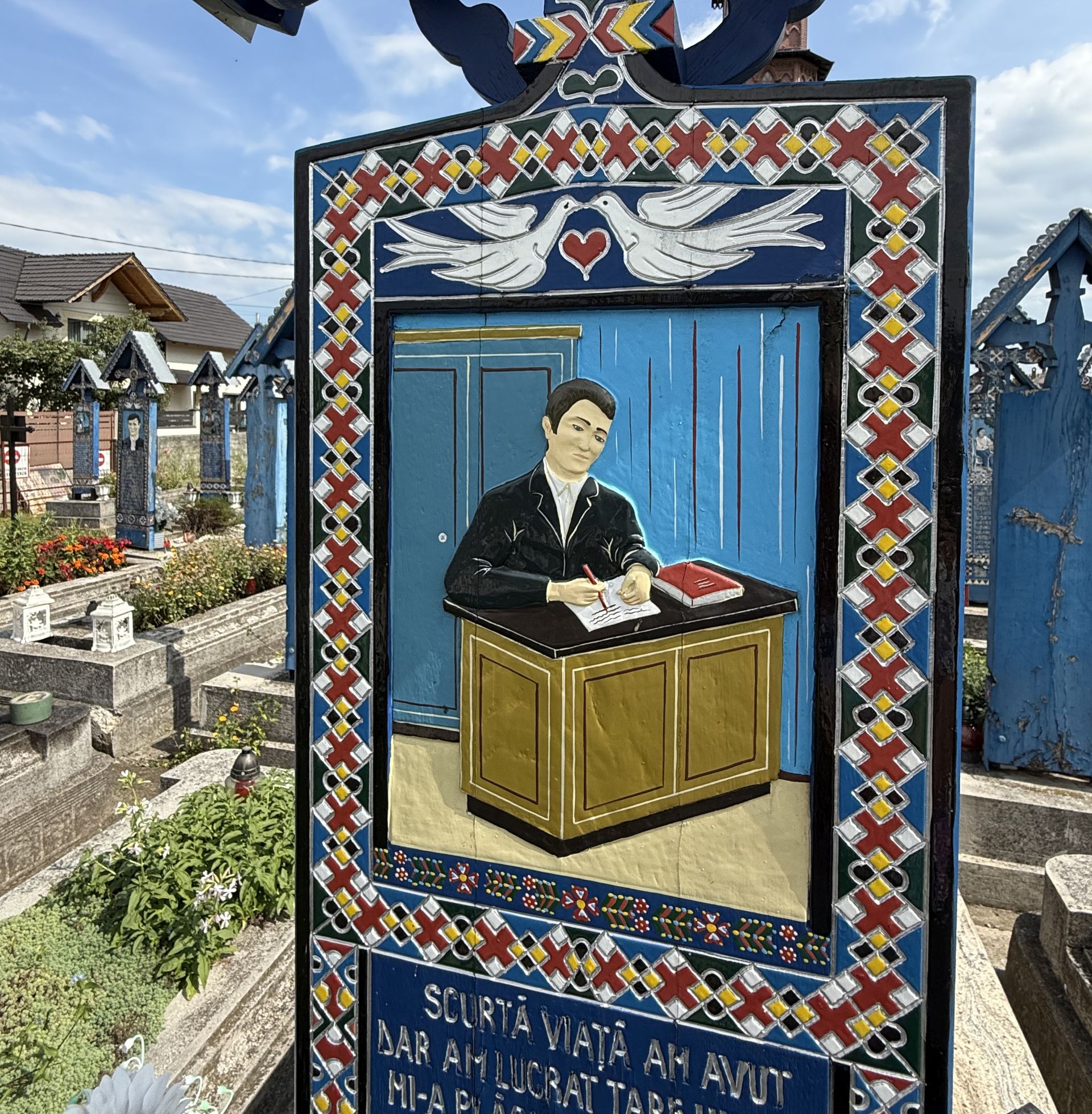
Fortunately, we had the opportunity to quietly observe the interesting paintings on the crosses: men cutting wood or working at the office, women spinning wool or cooking dinner, shepherds tending their sheep, teachers at their desk… But there were also tragic events: a young man killed by a train, a child drowning in a fast-flowing river, a toddler hit by a car…
No cross was complete without a short poem, which we – unfortunately – could not read, although I succeeded in finding some translations, e.g. for the cross that depicted a yellow taxi and a little girl.
May you burn in hell / Taxi from Sibiu / In all wide Romania / No other place you found /Except here near our house / To stop and hit me / And grief bring to my parents / For no pain is so deep / As when you son dies young / And no sorrow as great / As losing your young daughter / For as long as they live / Parents will weep for me / You’ll be forever in our thoughts / Dead at age 3 1978

Another famous epitaph was written by a son-in-law:
Underneath this heavy cross / Lies my poor mother-in-law / If she had lived three more days / I’d be lying here, and she’d be reading this / You, who pass by, try not to wake her up / For if she comes back home / She’ll start nagging at me again / So I’ll carry her this way / And never bring her back / You who read these lines, / May you not suffer like me / Find a good mother-in-law, / And live well with her. / She lived 82 years. +1969
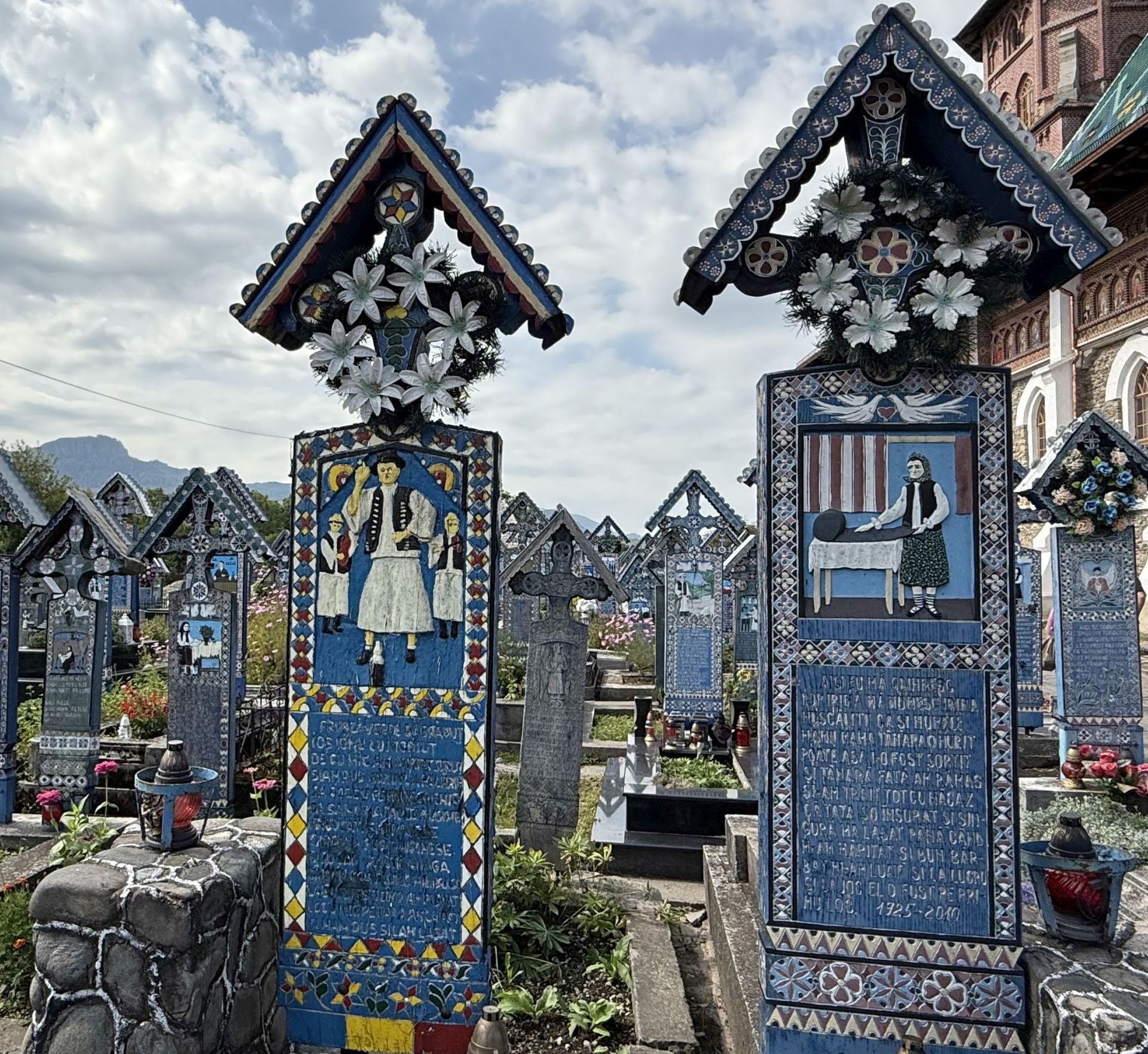
Walking around the Merry Cemetery made me think about death, but also about life. I think that it was one of the most surprising places I have ever visited.
No wonder that UNESCO recognized the Merry Cemetery as a part of Romania’s intangible cultural heritage in 2005.